
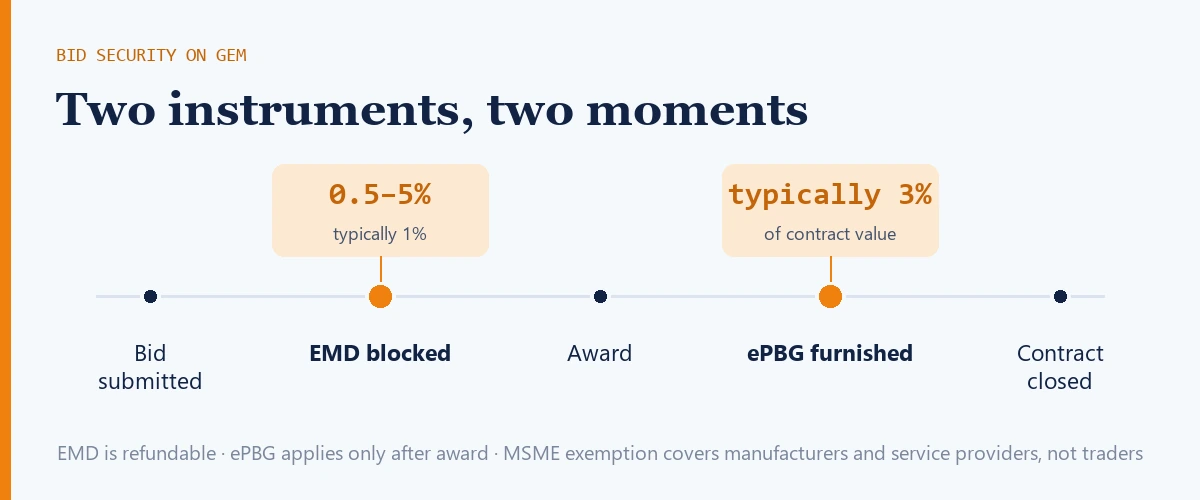
Two instruments on GeM take money out of your working capital, and sellers routinely confuse them. They apply at different moments, cover different risks, and have different exemption rules. Getting them wrong costs you either cash you did not need to block, or a bid that is rejected on a technicality.
EMD: a promise at bid stage
Earnest Money Deposit — bid security — is a commitment guarantee, not a fee. You furnish it when you submit; you get it back.
- How much: typically 1% of the estimated bid value, though the buyer can set it anywhere in a 0.5% to 5% range. Read the bid, do not assume 1%.
- When it is returned: after the bid process concludes, provided you did not withdraw after submission and your bid was compliant.
- When you forfeit it: withdrawing after submission, refusing an award, or failing to furnish the performance guarantee once selected.
The word “refundable” does a lot of quiet work here. It is refundable if you behave as your bid promised. Sellers who bid speculatively across many tenders and then withdraw from the awkward ones discover that EMD forfeiture is real.
ePBG: a promise after award
The electronic Performance Bank Guarantee is a different instrument at a different stage. It is furnished after you win, and it secures your performance of the contract rather than the seriousness of your bid.
- How much: commonly around 3% of contract value, though again this varies by bid.
- How long: it stays live for the contract period plus a defined tail, so it is blocked considerably longer than EMD.
The planning error we see most often is treating ePBG as a rounding error at bid time. On a high-value contract, EMD is small and short; ePBG is larger and long. Sellers who model only the EMD win the order and then discover their bank limit will not stretch to the guarantee.
Model both before you bid on anything material. If your working capital cannot carry the ePBG for the contract duration, that is a reason not to bid — not a problem to solve after the award letter arrives.
The MSME exemption, and its sharp edge
EMD exemptions for MSMEs and recognised startups are real, widely available, and badly under-used. They are also narrower than most sellers assume.
The exemption under the MSME category reaches manufacturers of goods and providers of services. It does not reach traders. A reseller with valid Udyam registration is still an MSME — but that does not, by itself, buy an EMD exemption on a goods bid.
This matters because a large share of GeM sellers are resellers who hold Udyam registration and reasonably assume the exemption applies to them. Claiming it wrongly is not a neutral mistake: the bid is treated as non-compliant on bid security, and you lose the tender on paperwork rather than on price.
To claim the exemption properly you need:
- valid Udyam registration, current and matching your GeM entity;
- your GeM seller profile MSME-tagged and verified with the supporting documents actually uploaded;
- the correct declaration attached to the bid, in the form the bid asks for;
- the underlying eligibility — that you are the manufacturer or service provider, not a trader.
The profile tagging is the step sellers skip. An Udyam certificate sitting in a folder on your desktop does nothing; the exemption is checked against your verified GeM profile.
Related relief worth knowing about
Micro and Small Enterprises also get relief beyond bid security. Where the bid permits it, MSEs are commonly exempted from bidder turnover criteria and from experience criteria, subject to meeting the quality and technical specifications.
That is a significant door-opener for newer sellers, and the same discipline applies: the exemption depends on a verified profile and the correct declaration, and it never excuses failing the technical specification.
Reading the bid, not the general rule
Everything above describes the common pattern. The binding numbers are always in the specific bid.
Before committing effort, extract four things from the bid document:
- The EMD percentage and amount, and the accepted instrument.
- Whether exemption is permitted and in what form the declaration must be made.
- The ePBG percentage and validity period.
- Any buyer-specific additions to the standard terms.
If those four are not clear to you within ten minutes of opening the document, that is itself a signal about how much time the bid will consume.
What this looks like in practice
A seller who handles bid security well has done three unglamorous things in advance: their Udyam registration and MSME tagging are current and verified on the profile; their declarations exist as fill-ready templates rather than being drafted per bid; and they know their working capital ceiling, so the go/no-go on a large tender takes minutes rather than a week.
That is the whole discipline. It is not complicated, but it is the difference between a bid you can submit on time and one you abandon halfway.
If you want that set up once and reused across every bid, our bid participation and compliance services cover exactly this — and the first consultation is free.