
Local content decides purchase preference in a large share of government bids. It is also the declaration sellers are least able to defend when asked. Most can tell you which class they claimed; far fewer can produce the worksheet behind the number.
This is a guide to getting the classification right and being able to stand behind it.
The two classes
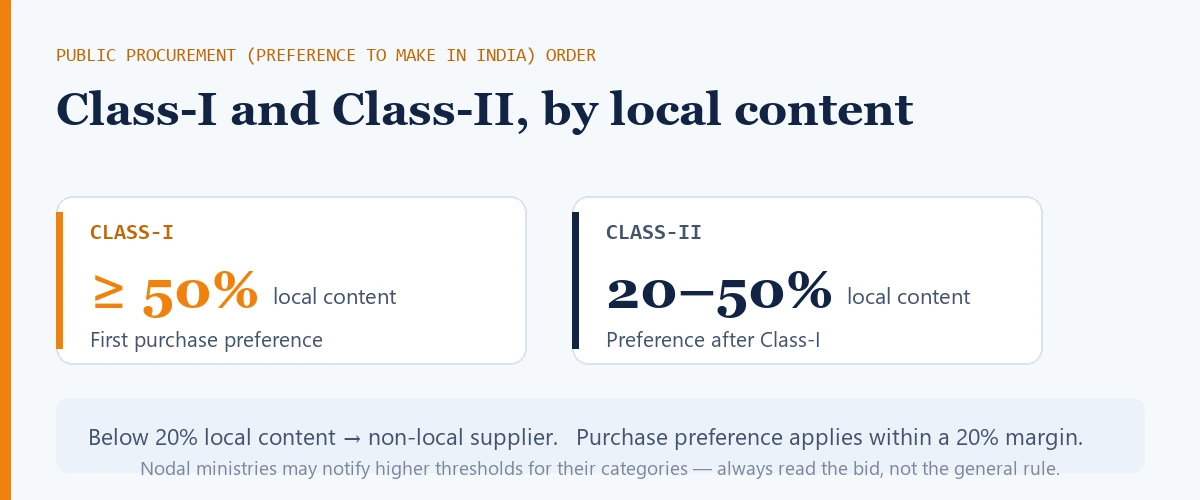
Under the Public Procurement (Preference to Make in India) Order, suppliers fall into three buckets by the local content in what they are offering:
- Class-I local supplier — local content of 50% or more.
- Class-II local supplier — local content above 20% but below 50%.
- Non-local supplier — local content of 20% or less.
Purchase preference flows in that order. Class-I gets first preference; Class-II follows; non-local suppliers get none.
How the preference actually works
The mechanism is a margin of purchase preference of 20%, and it is more specific than “Class-I always wins”.
If the lowest bid comes from a non-local supplier, the lowest-quoting Class-I supplier whose price falls within 20% of that lowest bid is given the opportunity to match it and take the order. If that supplier does not take it up, the opportunity can pass to the next Class-I supplier within the margin.
Two practical readings follow:
- Being Class-I is worth real money, but only if your price is within striking distance. A Class-I supplier quoting 40% above the lowest bid gains nothing from the classification.
- A modest price premium can be survivable in a way it would not be in a straight lowest-price contest. That is the commercial value of genuinely qualifying.
Thresholds are a floor, not a ceiling
The 50% and 20% figures are the general position. Nodal ministries and departments can notify higher minimum local content requirements for the categories they govern, and many have.
There has also been active policy discussion about raising the general thresholds — proposals to move Class-I to 70% and Class-II to 50% have been under consideration. Whether or not that lands, the operating lesson is unchanged:
Read the local content requirement in the bid in front of you. Do not apply a remembered number from a previous tender in a different category.
Sellers who standardise on “50% means Class-I” get caught the first time they bid into a category with a higher notified threshold.
Calculating local content defensibly
Local content is, in essence, the proportion of value that is domestic. The declaration is a percentage; the defence is a costing worksheet.
Build the worksheet once, structured like this:
- Total value of the offering — the basis your percentage is calculated against.
- Imported value — landed cost of imported components, sub-assemblies and bought-in services, including duties where relevant.
- Domestic value addition — locally sourced material, in-house manufacturing, local labour, local services.
- The resulting percentage, with the arithmetic visible rather than asserted.
Then keep the evidence that supports each line: purchase invoices, supplier declarations, bills of material, and costing records. The worksheet is the argument; the evidence is what makes it credible.
Where sellers get it wrong
- Counting the wrong things as local. Buying an imported component from an Indian distributor does not make its value domestic. The question is origin, not who invoiced you.
- Declaring at company level. Local content attaches to what you are offering in that bid, not to your business generally. Two products from the same factory can fall in different classes.
- Reconstructing under deadline. A worksheet assembled the night before submission is exactly the one that falls apart under audit.
- Never revisiting it. Your supply chain moves. A percentage that was accurate two years ago may not be today, and the declaration you sign is a current statement.
Certification and audit
Where the bid requires it, the declaration must be certified — commonly by a statutory auditor or cost accountant, depending on the value and the terms of the specific tender. Buyers are asking for supporting audits more often, not less.
Treat the certification as confirmation of a worksheet you already maintain, not as a document you commission from scratch each time. Sellers who keep the underlying costing current find certification straightforward. Sellers who do not find it expensive and slow, and occasionally discover the number they have been declaring is not supportable.
A false declaration is not a small problem
It is worth being blunt. The local content declaration is a formal statement made to a government buyer to obtain a commercial preference. Overstating it to qualify as Class-I is not aggressive bidding; it is a misrepresentation, and the consequences on GeM reach the seller account rather than just the bid — up to and including action that stops you receiving orders at all.
If your number is genuinely between classes, declare the class you can defend. A Class-II declaration you can prove is worth more than a Class-I claim you cannot.
A short checklist
Before you submit anything claiming local content:
- The bid’s own local content threshold has been read, not assumed.
- The percentage is for this offering, not the company.
- A costing worksheet exists, with imported and domestic value separated.
- Supporting invoices and supplier declarations are on file.
- The certification the bid requires is in hand, in the required form.
- The declaration is signed by someone authorised to make it.
That is a half-day of work the first time and minutes on every bid afterwards.
If you would rather have the worksheet built and the declarations standardised across your categories, compliance and statutory documentation is one of the things we do — and the first consultation is free.