
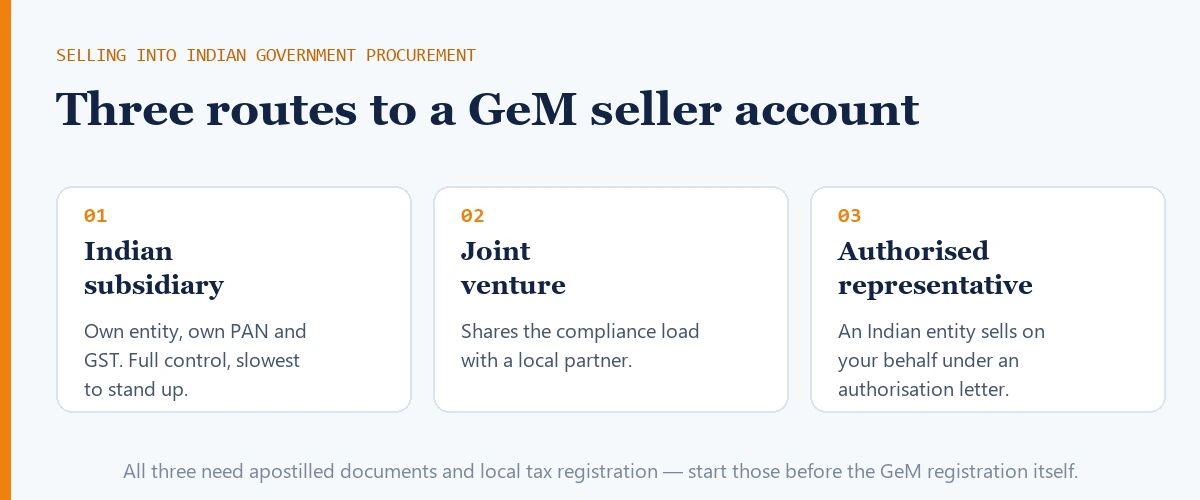
Indian government procurement is open to foreign manufacturers, but not on the same terms as the domestic market. The route you choose determines your tax position, your compliance load, how quickly you can start, and — crucially — how you fare against local content preference.
Choose it deliberately. Retrofitting a different structure once you have started is expensive.
The three routes
1. Indian subsidiary
You incorporate an Indian company that registers as the seller.
- Control: complete. Your own entity, your own PAN and GST, your own GeM account.
- Load: heaviest. Incorporation, ongoing corporate compliance, statutory filings, transfer pricing where you supply the subsidiary.
- Speed: slowest to stand up.
This is the right answer if India is a long-term market rather than an opportunistic one, and it is the structure that gives you the cleanest path to improving your local content position over time.
2. Joint venture
You partner with an Indian entity, sharing ownership and obligations.
- Control: shared, which is the whole point and the whole risk.
- Load: distributed — your partner typically carries local compliance.
- Speed: faster than incorporating alone, slower than appointing a representative.
The determining factor is not procurement. It is the quality of the agreement: who owns the customer relationship, who carries performance liability when an incident is raised, who holds the GeM account if the partnership ends. Get those wrong and the structure fails in exactly the situation you built it for.
3. Authorised Indian representative
An existing Indian entity sells on your behalf, holding the GeM account and the buyer relationship, under an authorisation from you.
- Control: least direct. Your representative is the seller of record.
- Load: lightest for you.
- Speed: fastest route in.
This is the common starting point, and it is a legitimate long-term structure. But your OEM authorisation letters are doing enormous work — they establish your representative’s right to offer your products, and they are scrutinised. Sloppy authorisations are a routine cause of bid rejection.
The bottlenecks are documentary, and they start early
Whichever route you take, the same three things hold projects up:
- Apostilled documents. Corporate documents originating outside India generally need apostille or consular legalisation. This is a fixed external delay measured in weeks and it cannot be compressed.
- Local tax registrations. PAN, and GST where applicable, must exist and must match the entity’s name across every record.
- Authorisation and brand documentation. Authorisation letters, trademark ownership evidence, and — for brand-owned listings — the brand approval process.
Start these before the GeM registration itself, not alongside it. The most common planning error we see with foreign OEMs is treating registration as step one and discovering that step one depends on documents that take six weeks to obtain.
The local content problem
This is the strategic issue, and it deserves more attention than the mechanics.
Indian public procurement gives purchase preference to suppliers with higher local content. Class-I suppliers — 50% or more local content — get first preference. Class-II — above 20% and below 50% — come next. Suppliers at or below 20% get no preference at all.
A foreign manufacturer importing finished goods and selling through an Indian representative is typically a non-local supplier. In categories where preference is applied, that is a structural disadvantage no amount of bid-writing overcomes.
The realistic responses:
- Compete where preference does not bite — categories or requirements where local supply cannot meet the specification.
- Increase local value addition — local assembly, local testing, locally sourced components — and be able to evidence it with a costing worksheet.
- Partner with a manufacturer who already qualifies, and structure the offering around their local content.
What does not work is declaring a local content percentage you cannot defend. The declaration is a formal statement to a government buyer, and the consequences of overstating it land on the seller account.
Country-of-origin restrictions
Where restrictions apply to suppliers from particular countries, eligibility must be confirmed before any bid effort is spent. This is a threshold question, not a detail to resolve during evaluation. It is also one where the answer can change, so a determination made two years ago should not be relied on today.
A realistic sequence
- Decide the route — subsidiary, JV or authorised representative — on commercial grounds, not on speed alone.
- Confirm eligibility for your country of origin in your target categories.
- Start the document chain — apostille, tax registrations, authorisations — because these gate everything.
- Assess your local content position honestly, and decide whether it needs changing before you invest in bidding.
- Register and build the catalogue.
- Screen a handful of live bids to see how preference actually plays out in your categories before committing to a pipeline.
Steps two and four are the ones that get skipped, and they are the ones that decide whether the rest is worth doing.
Where we come in
We advise foreign OEMs on entity structure, authorised representation and the compliance route into Indian government procurement — including the unglamorous document sequencing that determines your actual start date.
Beyond India, our global practice The Tender Brief covers international procurement markets, so if India is one of several you are entering, the same team can look at the whole map.
If you are weighing the three routes, the first consultation is free — tell us your product category and your country of origin, and we will tell you which route is realistic.